
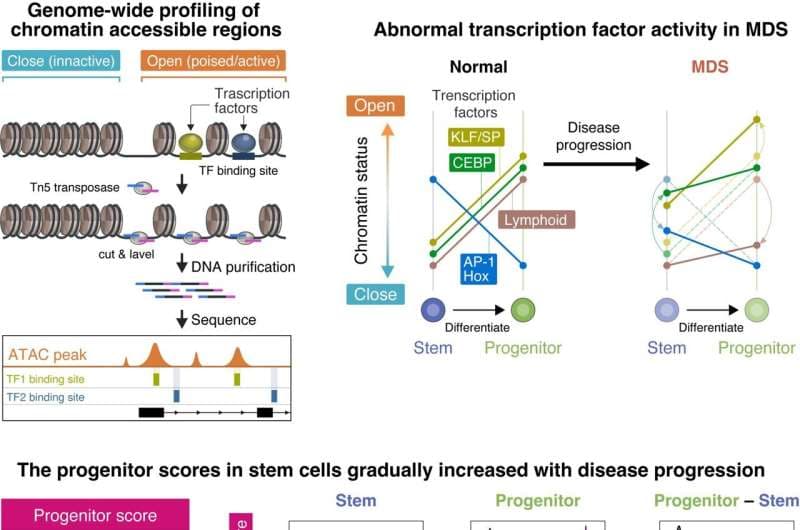
Over the past few decades, advances in hematology have illuminated how a delicate balance between stem cell self-renewal and differentiation sustains healthy blood formation. In myelodysplastic syndrome (MDS), however, this balance collapses, leading to abnormal blood cell development and a heightened risk of progression to acute myeloid leukemia. Despite major progress in genetics, the molecular events that trigger this transformation within stem cells have remained unclear. To address this, a research team led by Professor Atsushi Iwama and Senior Assistant Professor Motohiko Oshima from the Division of Stem Cell and Molecular Medicine, Center for Stem Cell Biology and Regenerative Medicine, The Institute of Medical Science, The University of Tokyo, Japan, has uncovered how chromatin accessibility, the way DNA is packaged and exposed, changes within blood stem cells as MDS develops. The study, published inNature Communications, provides a new insight into how stem cells lose their normal identity and evolve toward disease.
Uncovering the Molecular Events that Drive Blood Stem Cell Transformation in Myelodysplastic Syndrome
Phys News•
Full News
Share:
Disclaimer: This content has not been generated, created or edited by Achira News.
Publisher: Phys News
Want to join the conversation?
Download our mobile app to comment, share your thoughts, and interact with other readers.