
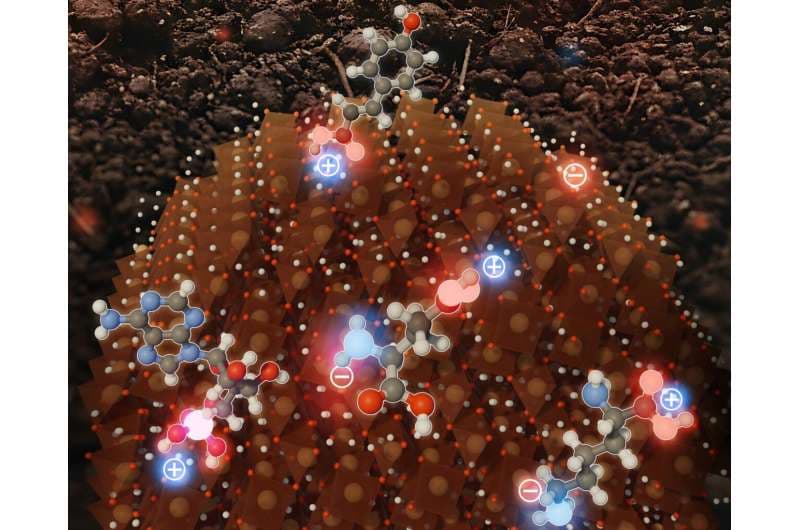
While scientists have long known that iron oxide minerals help lock away enormous amounts of carbon—sequestering it from the atmosphere—a new Northwestern University study now reveals exactly why these minerals are such powerful carbon traps. By exploring ferrihydrite, a common iron oxide mineral, engineers discovered it employs multiple, fundamentally different chemical strategies to grab carbon and lock it away. Although ferrihydrite has an overall positive electrical charge, the engineers found its surface is not uniformly charged. Instead, its surface resembles a nanoscale mosaic of positively and negatively charged patches. And ferrihydrite does not trap carbon using electrostatic attraction alone. It also uses chemical bonds and hydrogen bonding to form strong chemical links between its surface and organic materials. These unexpected strategies turn iron oxide minerals into highly versatile carbon snatchers, capable of grabbing and holding onto many different types of organic molecules. The findings offer new insight into how these minerals in soils trap carbon for decades or even centuries, preventing it from entering the atmosphere as climate-warming greenhouse gases.
Ferrihydrite's Surprising Strategies for Trapping Carbon: A Key to Soil's Long-Term Carbon Sequestration
Phys News•
Full News
Share:
Disclaimer: This content has not been generated, created or edited by Achira News.
Publisher: Phys News
Want to join the conversation?
Download our mobile app to comment, share your thoughts, and interact with other readers.