
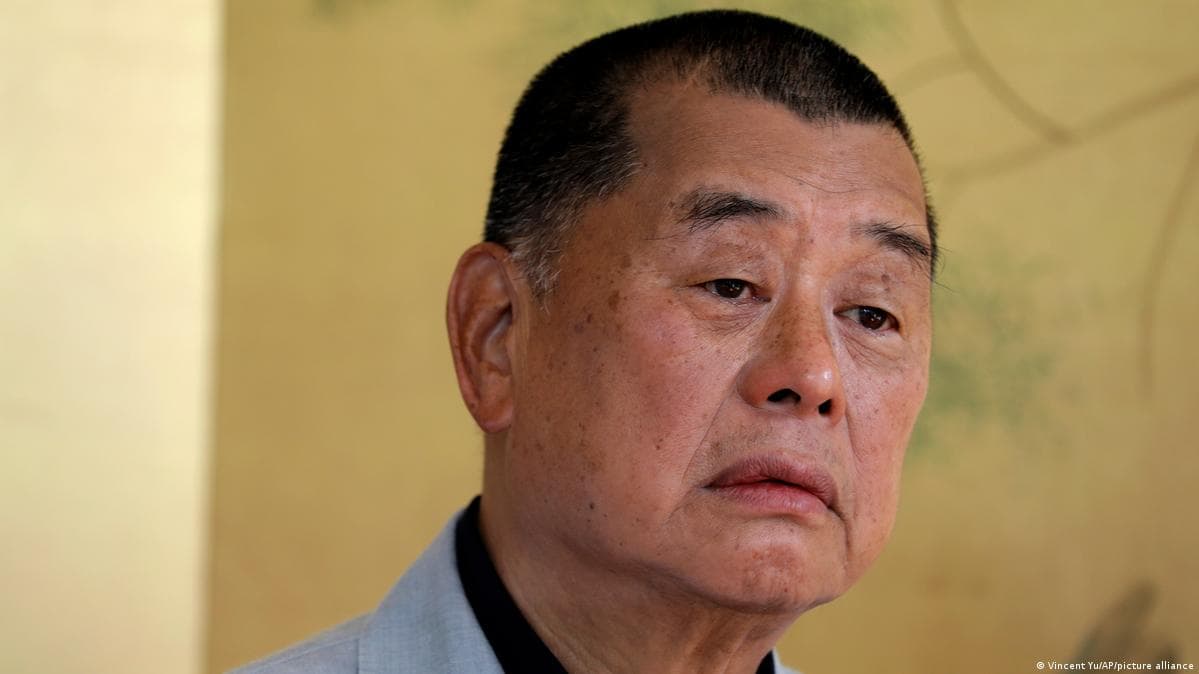
Pro-democracy media tycoonJimmy Lai was found guilty on Mondayof conspiracy to collude with foreign forces and of publishing seditious material under a Beijing-imposed national security law. The verdict, handed down by a three-judge panel at Hong Kong's High Court, could see Lai jailed for life. During the hearing, one of the three judges, Esther Toh, said the court had no doubt that Lai had "never wavered" in his intention to "destabilize"China, and that he harbored "hatred and resentment" toward the country. Lai, one of the most prominent critics of the Chinese Communist Party (CCP) leadership, was reportedly sitting impassively with his arms folded while listening to the ruling, flanked by several security officers. The 78-year-old defendant has been held in detention for five years andpreviously pleaded not guilty to all charges.A mitigation hearing is scheduled for January 12. His lawyer said Lai would decide after sentencing whether to appeal. To view this video please enable JavaScript, and consider upgrading to a web browser thatsupports HTML5 video At Monday's hearing before the verdict, Judge Toh noted that the written judgment spans 855 pages, with only selected portions read aloud in court. She said that "as early as before the implementation of the national security law… [Lai] sought to use the United States to counter China," citing messages between Lai and his assistant Mark Simon on the messaging app WhatsApp. The messages indicated that Simon had arranged meetings between Lai and US officials and lobbied on Lai's behalf. Lai, founder of the now-shutteredApple Dailytabloid,was also found guilty of using the newspaper to publish "seditious materials." During the2019 pro-democracy protests in Hong Kong, Lai'sApple Dailyserved as a key source of news for local and international audiences. Lai was first arrested in 2020, the same year Beijing imposed the sweeping national security law in Hong Kong to tighten its control over the former British colony, despite pledging to give it a high degree of autonomy ahead of the 1997 handover. His national security trial only began in December 2023, which was initially expected to last about a monthbut ultimately stretched to around 156 hearing days. "The lengthy verdict speaks nothing about the verdict's quality," Eric Lai, a senior fellow at Georgetown Center for Asian Law (GCAL), told DW. "The outcome of the trial is too certain: there's little room for the court to make a decision departing from Beijing's will," he added. To view this video please enable JavaScript, and consider upgrading to a web browser thatsupports HTML5 video Hong Kong and Beijing authorities both reject the increasing criticism of theerosion of the city's judicial independence. While Hong Kong leader John Lee said Lai harmed the fundamental interests of the country, Steve Li, chief superintendent of Hong Kong police's National Security Department, said: "Lai's conviction is justice served." But Eric Lai, the legal expert at GCAL, said the approach to Jimmy Lai's case is "a common tactic for authoritarian governments." Before the national security trial began, in 2022, the media tycoon wassentenced to five years and nine months in prison over separate fraud charges. The strategy was "to demoralize political dissent with non-political crimes, then punish them with tough security crimes to frame them as an enemy of the state," the expert said. Jimmy Lai's case is considered the first trial for theoffense of conspiracy to collude with foreign forcessince the national security law took effect in Hong Kong. It highlights the erosion ofpress freedomin the city, experts warn. GCAL's Eric Lai said the latest conviction indicates that "providing and disseminating critical and sharp opinions and information exchange with foreign actors are further affirmed as criminal." Elaine Pearson, Asia director at Human Rights Watch, said the verdict will have "a further chilling effect" on media freedom in Hong Kong. "Since the passage of the national security law, Hong Kong has gone from being a bastion of media freedom in Asia to a place where journalists face harassment and arrest," she told DW, adding, "many journalists have been forced into exile and some have been imprisoned." To view this video please enable JavaScript, and consider upgrading to a web browser thatsupports HTML5 video Since 2020, 14 media outlets have been shuttered in Hong Kong, includingStand NewsandJimmy Lai'sApple Daily, while those still working in the industry remain cautious in their reporting. "Just recently after the Tai Po fire, international media were summoned by the national security office and warned that there will be no tolerance for 'troublemaking,'" Pearson said, referring to a deadly inferno that broke out in Hong Kong in November. In the days after the fire, Hong Kong authorities increased police presence at mourning events and made multiple arrests by accusing unnamed actors of "using the disaster to stir up chaos." Several international human rights groups condemned Jimmy Lai's conviction on Monday and called on governments to step up pressure on China to secure his release. "Concerned governments should be pressing for the release of Jimmy Lai on humanitarian grounds at least. He is a 78-year-old man who has already spent five years in solitary confinement," Pearson said. The UK government has voiced concerns over the verdict against Lai, a British citizen, condemning what it described as "politically motivated persecution" and calling for the national security law to be repealed. Jimmy Lai's son, Sebastien Lai, urged the UK government to "do more" to help free his father. "It's time to put action behind words and make my father's release a pre-condition to closer relationships with China," Sebastien Lai told a press conference in London. His family also pointed to Lai's deteriorating health, noting that he suffers from diabetes and high blood pressure, among other issues. To view this video please enable JavaScript, and consider upgrading to a web browser thatsupports HTML5 video The US did not immediately respond to Lai's latest conviction, but President Donald Trump raised Lai's case with Chinese President Xi Jinping in a meeting in October and has vowed to "do everything I can" to secure his release. China's Foreign Ministry, meanwhile, urged other countries to "not make irresponsible remarks on the trial of judicial cases in Hong Kong and not to interfere in Hong Kong's judiciary or China's internal affairs in any form." GCAL's Eric Lai said "it may be too early to judge whether external pressure is helpful or counterproductive," noting that foreign governments are more likely to respond after sentencing is announced. For now, since the media mogul has the legal right to appeal both his conviction and sentence, he underlined, "[only] time will tell how the legal battles go on." DW's correspondent Chia-Chun Yeh contributed to the report. Edited by: Srinivas Mazumdaru
Hong Kong Media Tycoon Jimmy Lai Found Guilty of Conspiracy and Sedition Under Beijing's National Security Law
DW•
Full News
Share:
Disclaimer: This content has not been generated, created or edited by Achira News.
Publisher: DW
Want to join the conversation?
Download our mobile app to comment, share your thoughts, and interact with other readers.