
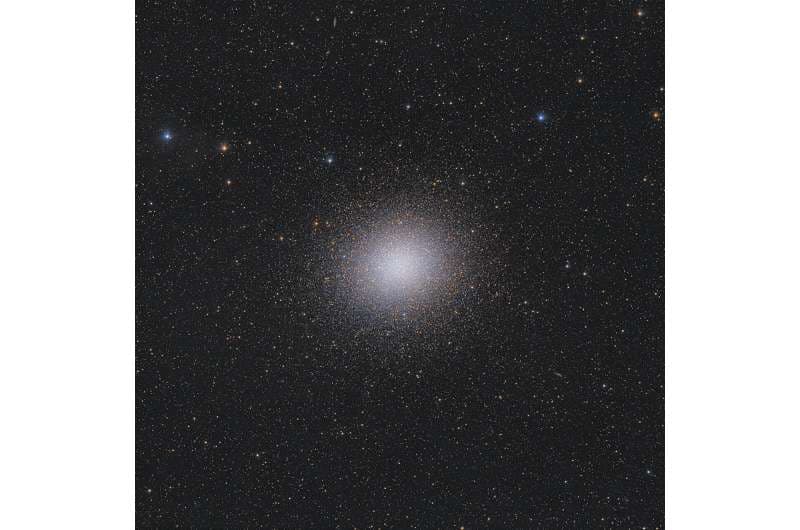
Omega Centauri dominates the southern sky as the Milky Way's largest and brightest globular cluster, a dense sphere containing roughly 10 million stars. Earlier this year, astronomers found evidence that an intermediate mass black hole hides within the cluster's core, revealed by seven stars moving far too quickly to remain bound unless something massive holds them gravitationally. Now, researchers have searched for the black hole itself using radio telescopes, and their discovery is what they didn't find. Intermediate mass black holes represent a missing link in our understanding of how black holes evolve. We know stellar mass black holes form from dying stars, with masses up to perhaps 200 times the sun. We know supermassive black holes weighing millions or billions of solar masses dominate galactic centers. But intermediate mass black holes, with masses between these extremes, remain frustratingly rare. Only a handful of candidates exist, and confirming them proves difficult. The recentHubble Space Telescopestudy tracked 1.4 million stars in Omega Centauri across two decades of observations. Seven stars in the cluster's innermost region move so rapidly they should escape entirely, yet remain bound. The gravitational pull keeping them corralled suggests a black hole with at least 8,200 solar masses, though estimates reach as high as 47,000 solar masses. Angiraben Mahida and colleagues decided to search for the black hole's accretion signature. When black holes feed on surrounding gas and dust, the material forms a hotaccretion diskthat emits across the electromagnetic spectrum, including radio waves. The team used the Australia Telescope Compact Array to observe Omega Centauri's central region for approximately 170 hours, achieving a sensitivity of 1.1 microjanskys at 7.25 gigahertz. This represents the most sensitive radio image of the cluster ever obtained.
Omega Centauri's Elusive Intermediate Mass Black Hole: A Radio Silence
Phys News•
Full News
Share:
Disclaimer: This content has not been generated, created or edited by Achira News.
Publisher: Phys News
Want to join the conversation?
Download our mobile app to comment, share your thoughts, and interact with other readers.