
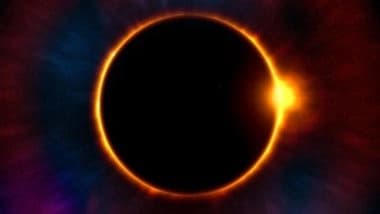
Mumbai, February 16:Space enthusiasts and skywatchers are preparing for the first major celestial event of the year as an Annular Solar Eclipse, popularly known as the "Ring of Fire," is set to occur on Tuesday, February 17, 2026. During this event, the Moon will align between the Earth and the Sun, but due to its distance, it will not fully cover the solar disk, leaving a thin, blazing outer ring visible. While the phenomenon will capture global attention, the path of annularity is restricted to the Southern Hemisphere, primarily passing over Antarctica and parts of the Southern Ocean. In India, the Surya Grahan will not be visible as the astronomical event takes place during the late afternoon and evening hours when the Sun will already be below the horizon for the Indian subcontinent. According to the National Aeronautics and Space Administration (NASA), partial phases of the eclipse will be visible in southern parts of Africa, South America (including Argentina and Chile), and Australia. For Indian observers, the event can only be witnessed via live streams provided by various space agencies.Annular Solar Eclipse 2026 Date and Time: Will ‘Ring of Fire’ Be Visible From India? According to Indian Standard Time (IST), the eclipse is scheduled to begin at 3:26 PM on February 17 and will conclude at 7:57 PM. The maximum eclipse, the moment the "Ring of Fire" reaches its peak, is expected around 5:42 PM IST. The entire duration of the celestial event will last approximately four hours and 31 minutes. While the "Ring of Fire" effect itself will only last for about 2 minutes and 20 seconds at its peak, the partial phases will provide a longer spectacle for those in the visibility zone. Because the eclipse is occurring in the zodiac sign of Aquarius (Kumbh Rashi) and under the Dhanishta Nakshatra, it also holds significant weight in Vedic astrology.2026 Stargazing: Eclipses, Meteor Showers and Supermoons. In Hindu tradition, the Sutak Kaal is a period of "spiritual impurity" that begins 12 hours before a solar eclipse. During this time, many devotees follow specific dietary and religious restrictions. However, a fundamental rule of Vedic astrology is that Sutak Kaal only applies in regions where the eclipse is physically visible. Since the February 17 Surya Grahan is not visible in India, no Sutak Kaal will be observed across the country. Temples will remain open, daily prayers can continue as usual, and there are no religious prohibitions on cooking or eating. For those living in regions where the eclipse is visible, the traditional Sutak rules include: An annular solar eclipse differs from a total eclipse because of the Moon’s elliptical orbit. On February 17, the Moon will be near its apogee (the point farthest from Earth), making it appear slightly smaller in the sky than the Sun. Consequently, it cannot block the entire solar surface, resulting in the characteristic glowing halo. Astronomers emphasise that even if only a small portion of the Sun is visible, looking at it without certified ISO-rated solar filters or eclipse glasses can cause permanent eye damage. Residents in the Southern Hemisphere are urged to use indirect viewing methods, such as pinhole projectors, to enjoy the sight safely. TruLY Score 3 – Believable; Needs Further Research | On a Trust Scale of 0-5 this article has scored 3 on LatestLY, this article appears believable but may need additional verification. It is based on reporting from news websites or verified journalists (Times of India), but lacks supporting official confirmation. Readers are advised to treat the information as credible but continue to follow up for updates or confirmations (The above story first appeared on LatestLY on Feb 16, 2026 07:07 PM IST. For more news and updates on politics, world, sports, entertainment and lifestyle, log on to our websitelatestly.com).
Annular Solar Eclipse 2026: 'Ring of Fire' to Occur on February 17, But Will It Be Visible From India?
Latestly•
Full News
Share:
Disclaimer: This content has not been generated, created or edited by Achira News.
Publisher: Latestly
Want to join the conversation?
Download our mobile app to comment, share your thoughts, and interact with other readers.