
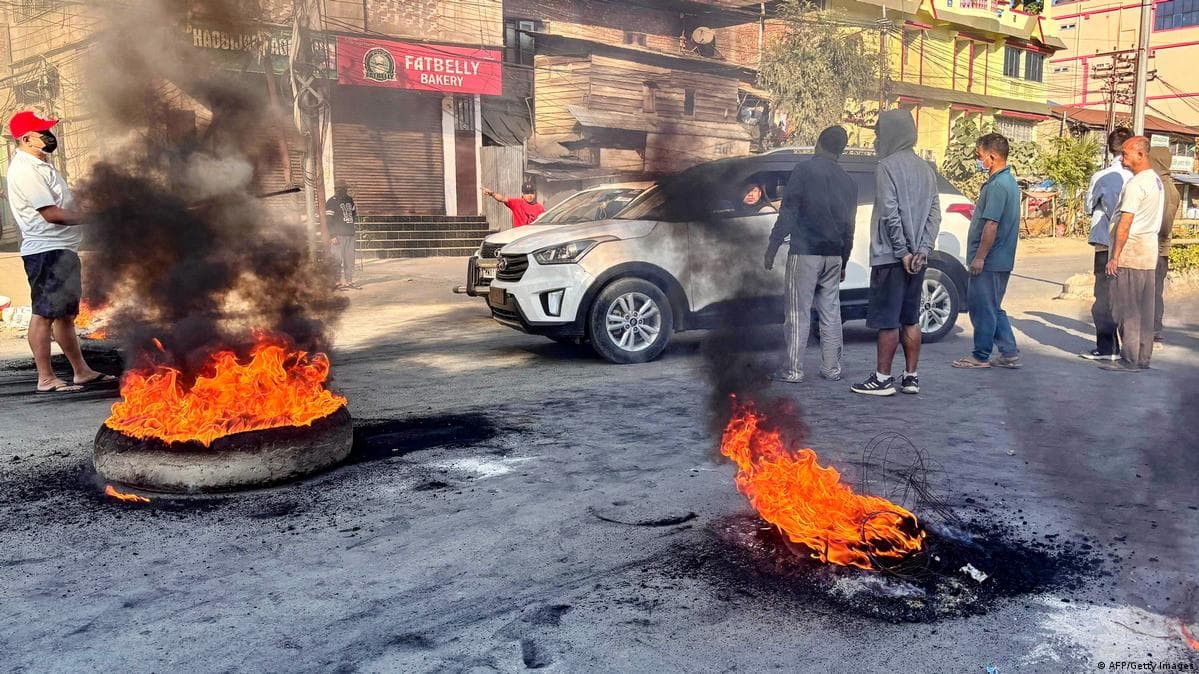
Fresh violence erupted inIndia's northeastern Manipur statein recent days, prompting authorities to impose a curfew and suspend internet to restore peace. The unrest began after a member of the Tangkhul Naga community was allegedly assaulted by several people in Ukhrul district's Litan Sareikhong village. It escalated later with reports of houses being set ablaze and many villagers displaced. The government has sent additional security forces to restore calm. "The situation remains volatile, with security forces deployed to bring the area under control," a senior police officer told DW. For political scientist Bidhan Laishram, the latest flare-up "is part of a continuum." "It points to the limits of identity politics because at the heart of the Manipur issue lies an unbridled form of identity politics unable to be moderated by a history of coexistence," he told DW. To view this video please enable JavaScript, and consider upgrading to a web browser thatsupports HTML5 video The violence casts a pall overefforts by New Delhi to stabilize the restive regionthat has been beset by ethnic turmoil for nearly three years. In May 2023, long-standing grievances between the Meitei and Kuki communities inManipur erupted into clashes. The majority Meitei live predominantly in the state's Imphal valley, while the Kuki populate the surrounding hill regions. The violence started after the Meiteis demanded official tribal status, which bestows privileges such as job quotas and land rights. The Kukis fear they will be further marginalized if the Meiteis secure the tribal status. Some 260 people have been killed and more than 60,000 displaced since the violence first broke out. Many livelihoods have been destroyed, andnormal life fractured along hardened communal lines. Pradip Phanjoubam, editor of the Imphal Review of Arts and Politics, who has been chronicling events since the conflict broke out, told DW that it is not just a fight between Meiteis and Kukis. "Nagas and all ethnic groups must be involved. We need to stop selective empathy where each side only feels their own pain. All parties must recognize everyone has suffered and find shared healing," he said. In February 2025,India'sgovernment imposed — not for the first time — "president's rule" on the conflict-ridden state, a constitutional provision that takes power away from a state government in times of crisis. But the promise of peace that came with the federal government's direct control over Manipur proved elusive. Nearly a year after it was imposed, president's rule in the state was lifted last week, clearing the way for the formation of a new elected government. Yumnam Khemchand Singh, from the Meitei community, was sworn in as chief minister, while two other leaders — one each from the state's Kuki and Naga communities — were named deputy chief ministers. The power-sharing arrangement appears designed to send a message that all three major communities had stakes in state governance and would work together for peace. But the latest clashes underscore thelimitations of the government's approach to resolving the ethnic tensions. "The installation of popular government and the inter-ethnic power-sharing model, at the political level, is a positive step forward. However, the escalating violence clearly demonstrates the limitations of the prescriptive top-down approach to building peace," Babloo Loitongbam, director of the NGO Human Rights Alert (HRA), told DW. He believes a sustainable peace can only emerge when all affected communities come together and own the process. "The key challenge is who will provide that safe space where the stakeholders can truthfully share their grievances and aspirations. Who will create that nurturing environment to listen to each other, develop empathy with the needs of the other side, and co-create a way forward?" the rights activist pointed out. As tensions persist, hard-line positions continue to gain ground. The Kuki-Zo Council, for instance, has demanded the establishment of a separate autonomous region for the community. "Unless there is a real effort to solve issues, the problems will fester. We demand a separate autonomous administration. For the Kuki people, autonomy is not a negotiating tactic but a prerequisite for dignity, security, and equality," Ajang Khongsai, president of Kuki Inpi Manipur, the apex body of the Kuki people, told DW. Some observers say Manipur is likely to oscillate between episodic flare‑ups and uneasy calm in the near term, with no real prospect of a lasting political solution. Phanjoubam stressed that lasting peace hinges on sustained neutral mediation and inclusive, open dialogue among the affected communities. "Only honest, inclusive dialogue acknowledging mutual trauma can break the cycle of violence and build lasting peace." Edited by: Srinivas Mazumdaru
Fresh Violence Erupts in Manipur Amid Ongoing Ethnic Tensions
DW•
Full News
Share:
Disclaimer: This content has not been generated, created or edited by Achira News.
Publisher: DW
Want to join the conversation?
Download our mobile app to comment, share your thoughts, and interact with other readers.