
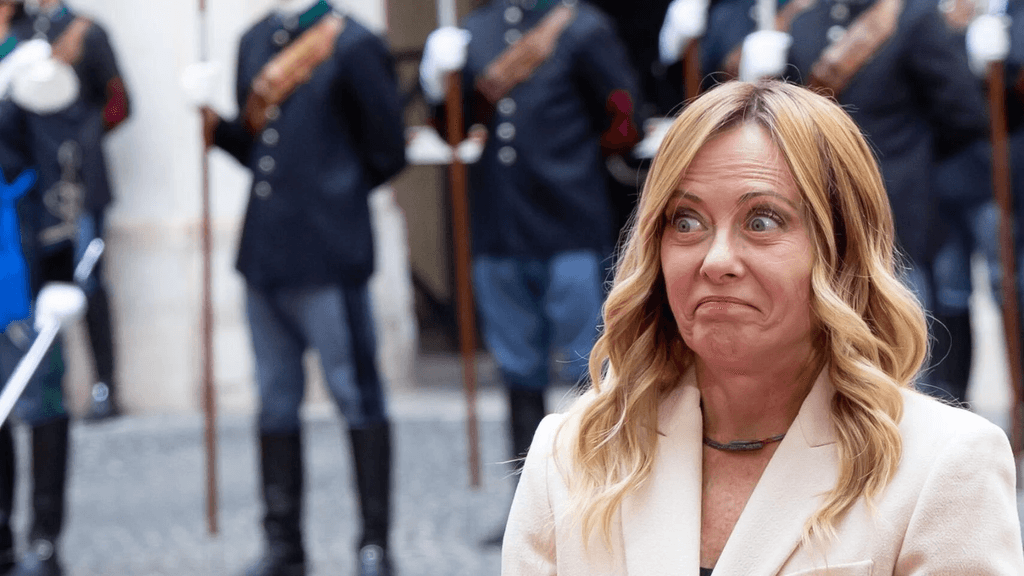
Italian Prime Minister Giorgia Meloni is taking an unusual legal step in the fight against artificial intelligence-generated deepfakes: she has filed an application to protect her distinctive voice as an EU sound trademark. The application was submitted to the European Union Intellectual Property Office on October 5, 2026, and includes a four-second recording in which Meloni says, “Io sono Giorgia Meloni,” or “I am Giorgia Meloni,” twice. The application is still under examination, meaning the protection has not yet been granted. The move comes as AI voice-cloning tools become increasingly capable of reproducing a person’s tone, cadence and accent from short audio samples. For a political leader, a convincing fake recording can create a particularly serious problem if it appears to show her making statements she never made. Meloni’s filing is therefore less about owning a sentence and more about creating another legal route to challenge the unauthorized commercial use of a recognizable vocal identity. Meloni has applied for an EU sound trademark rather than simply trying to copyright her voice. Under EUIPO rules, sound marks can be represented through an audio file, allowing a particular sound or combination of sounds to receive trademark protection when it meets the legal requirements for registration. In Meloni’s case, the submitted recording lasts about four seconds and consists of her saying “Io sono Giorgia Meloni” twice. Italian news agency ANSA reported that the application covers areas including downloadable multimedia content, cultural activities and the organization of political events. The application remains under review, so it is important not to describe Meloni’s voice as already trademarked. The phrase is strongly associated with the Italian prime minister. Meloni famously used “Io sono Giorgia” during a political rally in 2019. The phrase later became the title of her 2021 autobiography, cementing it as part of her public identity. Its inclusion in the sound-mark application also makes the recording relatively easy to identify. But the legal significance lies primarily in the sound recording itself, not in the four words as a piece of language. Trademark protection does not give Meloni exclusive ownership of the Italian words. Someone else remains free to say “Io sono Giorgia Meloni.” The issue is the protected sound mark and the goods or services for which it is registered. In the EU, sound marks are a recognized category of trademark. EUIPO regulations allow an applicant to submit an audio file representing the sound being claimed. The sound must satisfy the same basic trademark principles that apply to other marks, including the requirement that it be capable of distinguishing the relevant goods or services. This means Meloni is not literally placing a legal lock around every recording of her voice. Instead, she is attempting to establish a protected commercial identifier associated with her voice. That distinction becomes especially important in the age of AI. A voice can be copied and manipulated in ways that were difficult or impossible only a few years ago. A sound-mark registration could give the owner another legal basis for challenging certain unauthorized uses. No. A trademark application does not technically prevent an AI model from generating an imitation of someone’s voice. Even if the application is approved, an AI system could still be capable of producing synthetic audio that resembles Meloni. The potential benefit is legal rather than technological. A registered sound mark could make it easier to challenge certain unauthorized uses, especially where the cloned voice is used commercially or in connection with services covered by the trademark. That could prove useful for requesting the removal of infringing content or pursuing legal remedies against parties responsible for its distribution. It would not, however, make every AI-generated imitation automatically illegal. A fake image of a politician can be questioned. A convincing audio recording can be much harder for an ordinary listener to identify as synthetic. That creates an obvious risk during elections or political crises. A fabricated recording could falsely portray a politician making a controversial announcement, endorsing a product, threatening an opponent or giving instructions to supporters. The danger comes from the combination of familiarity and plausibility. People already know what a public figure sounds like, so a realistic AI recreation can feel more authentic than an obviously manipulated photograph. Meloni has previously warned about this problem and argued that deepfakes can deceive and manipulate people who lack the resources to defend themselves. Yes. Meloni has previously been the target of manipulated digital content, including sexually explicit fake images. In 2024, she launched a civil lawsuit against a man accused of creating and distributing deepfakes pornography using her likeness. The case has remained part of Italy’s wider debate over how existing laws should deal with AI-generated abuse. The latest voice filing follows the same basic concern but addresses a different part of her identity. Instead of protecting only her face or image, Meloni is attempting to establish additional legal protection around one of the most identifiable features of a public speaker: her voice. An EU trademark registration would generally provide protection throughout the European Union for the goods and services covered by the registration. That could give Meloni a stronger position when challenging certain commercial uses of a synthetic voice that reproduces the registered sound. For example, the registration could potentially become relevant if someone used an AI-generated version of her voice to promote a product, distribute commercial multimedia material or create content falling within the protected categories. The precise scope would depend on the final registration and the services covered. It would not automatically give Meloni control over every recording, parody, political discussion or non-commercial use involving a voice that resembles hers. Trademark law has limits, and those limits would remain important in any dispute. Copyright and trademark law protect different things. Copyright generally concerns original creative works, while trademarks are intended to identify and distinguish goods or services. A person’s voice is not automatically a copyrighted work simply because it belongs to that person. A sound trademark offers a different route. The distinctive sound can function as an identifier in the marketplace. That may make the approach particularly attractive in the AI era, where the commercial misuse of a recognizable voice can be difficult to fit neatly into older copyright frameworks. Meloni’s application is therefore an example of existing intellectual-property law being tested against a new technological problem. Meloni is not the first Italian public figure to pursue sound-mark protection. Singer Giusy Ferreri has also registered a distinctive voice-based mark, while voice actor Luca Ward has pursued protection for his recognizable vocal identity. Their cases illustrate why voice can have commercial value independent of a person’s face. A singer’s voice is central to her career. A voice actor’s timbre may be immediately associated with movie characters, commercials and dubbed performances. AI-generated voice cloning threatens to blur that relationship because software can reproduce the characteristics that audiences previously associated almost exclusively with the original performer. The dispute involving Scarlett Johansson became one of the most prominent recent examples of the controversy surrounding AI-generated voices. Johansson objected after OpenAI introduced a voice for ChatGPT that she said sounded remarkably similar to her own. She had previously said she declined an offer to provide her voice for the system. OpenAI denied deliberately copying her voice, saying the similarity was not intended. The company later stopped offering the particular voice after the controversy erupted. The episode demonstrated how difficult it can be to distinguish between inspiration, resemblance and unauthorized replication when AI systems are capable of generating speech with highly humanlike characteristics. A recent ruling in Japan has added another important piece to the international legal debate. The Tokyo District Court ruled that a person’s voice can fall under publicity rights, recognizing that a human voice can be an expression of individual personality similar to a person’s likeness. The case involved Japanese voice actor Kenjiro Tsuda, who challenged the unauthorized use of AI-generated speech resembling his distinctive voice. The court recognized the legal importance of voice but dismissed his request to remove the disputed videos because the content had already been deleted. The ruling is significant because it shows that courts in different jurisdictions are beginning to confront AI voice cloning through existing personality and publicity-rights frameworks. Not exactly. The filing does not necessarily establish a completely new category of personal rights over a person’s voice. Instead, it uses an existing intellectual-property mechanism, the sound trademark, to create a potentially useful additional layer of protection. The distinction matters. Trademark law is generally concerned with commercial identification and the use of protected marks. Personality rights, privacy law and other legislation can address different forms of misuse. Meloni’s strategy therefore appears to be one of adding another tool to the legal toolbox rather than claiming that a trademark can solve the entire deepfake problem. The timing is significant because AI-generated political content is becoming harder to distinguish from authentic recordings. A fabricated speech or phone call can be generated rapidly and distributed across social media before journalists or fact-checkers have time to verify it. For political leaders, that creates a communications problem as well as a legal one. A trademark may help after a fake has been created, but it cannot stop misinformation from spreading during the crucial first few hours. That means legal protection will need to operate alongside platform moderation, digital authentication tools, media literacy and rapid verification systems. Potentially, although the protection would have limits. A verified sound mark could provide another legal basis for challenging certain commercial or promotional uses of a cloned voice. But political speech sits in a complicated legal environment. Questions involving parody, criticism, journalism, satire and political expression cannot automatically be resolved through trademark law. That means an approved registration would not give Meloni the power to erase every AI-generated recording in which someone imitates her. Its strongest value may instead lie in cases where a fake is presented commercially or in circumstances that create confusion about the source of the material. The recording is tiny, but its significance is much larger than its length suggests. Modern voice-cloning systems can extract substantial information about a person’s vocal characteristics from relatively short samples. The four-second clip provides a controlled recording of Meloni’s voice saying a distinctive phrase. For legal purposes, the important issue is establishing exactly what sound is being claimed and associating it with the relevant services. In practical terms, the recording becomes a kind of acoustic fingerprint for the trademark application. The biggest limitation is that a trademark is not an anti-deepfakes technology. It does not identify synthetic audio automatically. It does not prevent anonymous users from generating fake recordings. And it does not guarantee that platforms will remove every disputed clip immediately. There is also a jurisdiction issue. An EU trademark has a geographic scope, while AI-generated content can be created and distributed anywhere in the world. A fake recording produced outside the EU can quickly reach European audiences through global platforms. That means enforcement could become complicated even if Meloni’s application is approved. Meloni’s case arrives at a moment when lawmakers, courts and technology companies are searching for new ways to protect people’s identities from synthetic media. The underlying problem is not limited to politicians. Actors, musicians, journalists, business executives and ordinary individuals can all be targeted by voice-cloning scams or fabricated recordings. What makes Meloni’s filing notable is that she is using a conventional intellectual-property mechanism to address a very modern threat. If the application succeeds, it could encourage other public figures and brands to explore sound trademarks as one part of a broader strategy against AI impersonation. It could also force courts to consider a new question more frequently: when does reproducing the sound of a person become an unlawful use of that person’s identity? Meloni’s EUIPO application is currently under examination. The office will assess whether the sound mark meets the requirements for registration and whether there are grounds for opposition or refusal. Until that process is complete, Meloni does not have the full protection associated with a registered EU sound mark. Whatever the outcome, the filing sends a clear signal about how quickly AI voice cloning has moved from a technical curiosity to a political and legal problem. “Io sono Giorgia Meloni” is only four seconds long. The legal question behind those four seconds is considerably bigger: who controls the commercial identity of a human voice when software can reproduce it almost perfectly?
Italy's PM Files Sound Trademark Application to Protect Her Voice from Deepfakes
Breezy Scroll•
Full News
Share:
Disclaimer: This content has not been generated, created or edited by Achira News.
Publisher: Breezy Scroll
Want to join the conversation?
Download our mobile app to comment, share your thoughts, and interact with other readers.