
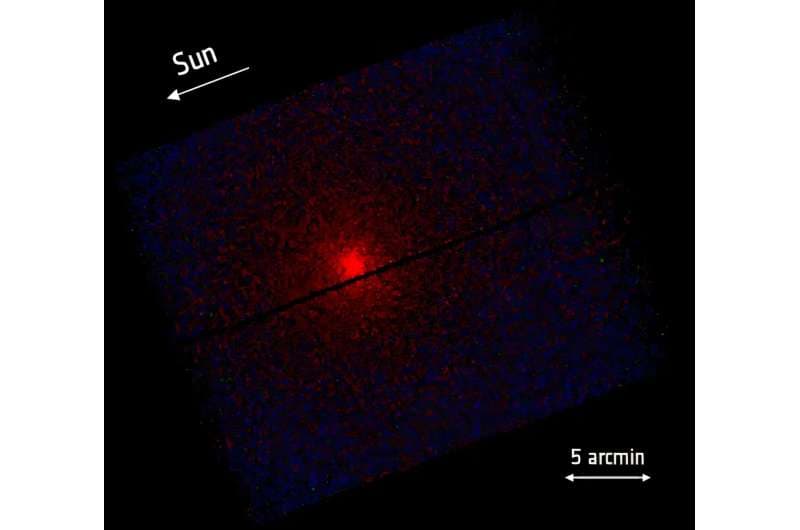
The European Space Agency's X-ray space observatory XMM-Newton observed interstellar comet 3I/ATLAS on 3 December for around 20 hours. During that time, the comet was about 282–285 million km from the spacecraft. XMM-Newton observed the comet with its European Photon Imaging Camera (EPIC)-pn camera, its most sensitive X-ray camera. This image shows the comet glowing in low-energy X-rays: blue marks empty space with very few X-rays, while red highlights the comet's X-ray glow. Astronomers expected to see this glow because whengas moleculesstreaming from the comet collide with the solar wind, they produce X-rays. These X-rays can come from the interaction of the solar wind with gases like water vapor, carbon dioxide, or carbon monoxide—which telescopes such as the NASA/ESA/CSA James Webb Space Telescope and NASA's SPHEREx have already detected. But they are uniquely sensitive to gases like hydrogen (H₂) and nitrogen (N₂). These are almost invisible to optical and ultraviolet instruments, such as the cameras on the NASA/ESA Hubble Space Telescope or ESA's JUICE.
XMM-Newton Observes Interstellar Comet 3I/ATLAS in Low-Energy X-Rays
Phys News•
Full News
Share:
Disclaimer: This content has not been generated, created or edited by Achira News.
Publisher: Phys News
Want to join the conversation?
Download our mobile app to comment, share your thoughts, and interact with other readers.