
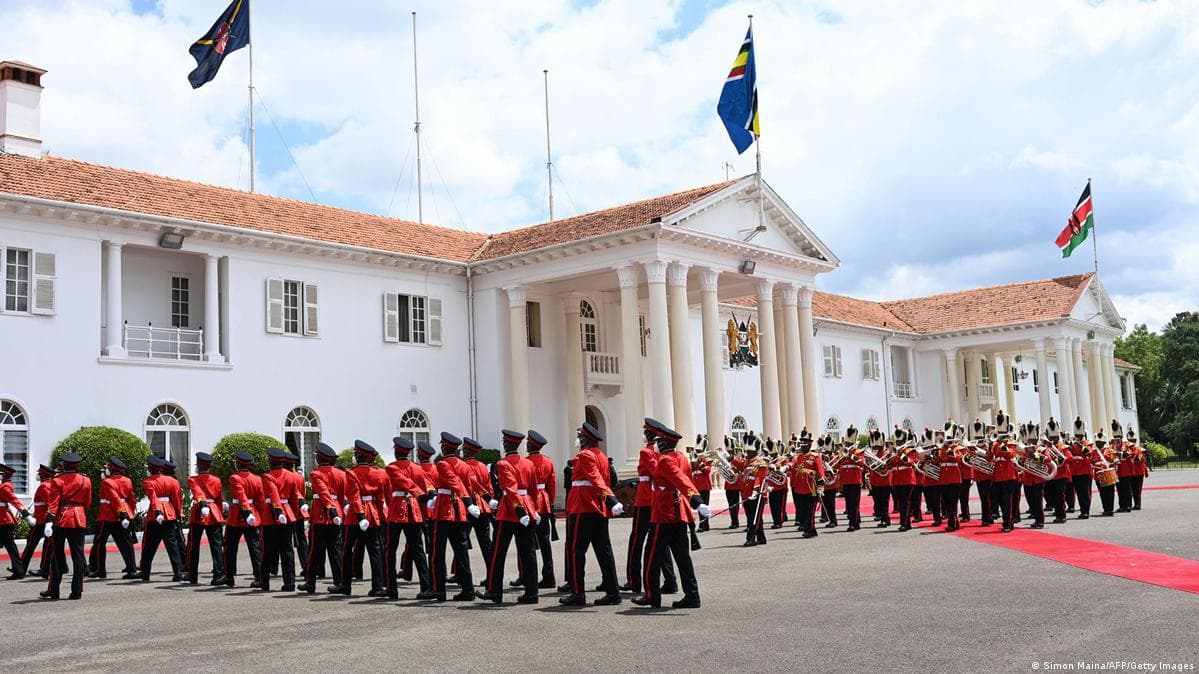
Kenya 's State House budget has drawn renewed scrutiny after the latest supplementary estimates pushed the allocation to about Sh16.9 billion (approximately $130 million, €112 million), up from Sh 8.6 billion, triggering debate among economists and fiscal analysts about government spending priorities and the structure of presidential budgets. The increase, which nearly doubled the original allocation for the 2025/26 financial year, has also fueled comparisons with the White House budget in the United States of America (US) . Some reports circulating in local political debate have suggested that Kenya's State House now spends more than its American counterpart, Nigeria, South Africa and several other countries. However, economists say such comparisons often overlook key structural differences in how presidential costs are accounted for in different governments. "In the US, many of the costs associated with running the presidency are distributed across several government agencies rather than concentrated under a single budget line," Rufas Kamau, an economist and financial markets researcher at Forbes Digital Assets, said. Critics accuse President William Ruto of misplaced priorities after his government nearly doubled the State House budget Image: Thomas Mukoya/REUTERS He said security for the US president, for instance, is handled by the Secret Service, while aircraft such as Air Force One fall under the Department of War (previously known as the Department of Defense). "Other logistical and administrative expenses are also spread across multiple departments within the federal government," Kamau told DW. Kenya's State House budget explained In Kenya, however, a larger portion of presidential operations is consolidated under the State House budget, making direct comparisons with the White House or other countries somewhat misleading. Kenya's State House budget covers a wide range of responsibilities beyond the president's immediate office. These include operations at State Lodges across the country, administrative services tied to the presidency and statutory benefits for retired presidents and deputy presidents. But even with those structural differences, economists say the sharp rise in Kenya's State House allocation raises legitimate concerns about transparency and fiscal discipline. Samuel Nyandemo, a senior lecturer in economics at the University of Nairobi, argues that the figures that the figures released by State House might even underestimate the true spending. "Most of this money is not properly accounted for," Nyandemo told DW, adding that limited disclosure around how the funds are used raises questions about oversight. He also questioned whether spending had remained within the limits approved by Parliament. "Firstly, State House was allocated some money through the budget which has been overutilized, meaning they are spending outside the approved budget reallocation, which is an illegality," he said. "They [State House in Nairobi] are living beyond their means." During his first State of the Nation Address, President William Ruto told Kenyans to tighten their belts as the country grappled with mounting debt. "We must admit that as a country, we had been living large and way beyond our means. The time has come, therefore, to retire the false comforts and illusory benefits of wasteful expenditure, and counterproductive subsidies on consumption by which we dug ourselves deeper into the hole of avoidable debt." Nyandemo said the current spending debate reflects wider concerns about whether resources are being directed toward the most urgent national needs. "Remember, currently the northeastern part of Kenya is facing severe drought ," he said. Pressure from rising public debt Kenya's growing public debt and fiscal pressures have put the spotlight on government spending across ministries and institutions. The East African nation has been implementing fiscal reforms aimed at stabilizing the economy and managing rising debt obligations, forcing policymakers to weigh competing priorities across sectors such as education, healthcare and social services. "Most of our educational programs are facing the need for the supply of critical facilities, including books, chairs, and employing extra teachers to meet the gap," Nyandemo pointed out, stressing that the health services sector is underperforming. "In most hospitals, patients are having no food. So that theory indicates that the priorities of the current government are misplaced or upside down." Other economists say the debate should move beyond comparisons with wealthy nations and instead focus on whether the spending reflects Kenya's own economic realities . "What we should really be asking is not how Kenya compares to the US in terms of raw numbers, but whether Sh16.9 billion is worth it or comparable to what Kenya actually needs," Kamau said. He added the scale of the allocation becomes harder to justify when viewed against the pressures many households and sectors of the economy are currently facing. "When you look at the things happening in the country right now, they do not really make sense, especially in terms of healthcare. We saw the government raising the premiums that people pay for medical insurance. On the other hand, the premiums are rising, but the returns people get, especially if they are sick, are much lower." Kamau noted that the issue becomes clearer when State House spending is viewed in the context of the broader demands on the national budget. "If you look at other things happening in the Kenyan economy, you get into a situation where State House spending has become significant spending for the government and also for the economy." He also questioned rising expenditures when government revenues remain under pressure. "Seeing the State House budget go up does not make sense, especially considering that we do not need a lot of this travel and maintenance in the State House budget at a time when we are going through a period where what we are consuming is much higher compared to what we are generating in terms of revenue for the government account." Calls for stronger accountability Kamau adds that comparisons within Africa further highlight the scale of the spending. "For example, Nigeria has a population of about 220 million people and spends about 3.1 billion Kenyan shillings on the presidency. In Kenya, we are spending about 16.9 billion for a population of almost 60 million people. Clearly, the appetite for taxpayer money is much higher in Kenya compared to many other nations," he added. For Nyandemo, the State House should reassess how it is using resources and ensure spending aligns with approved budget limits. "State House needs to adjust its extravagancy and wastages and stick to the budget," he said. "It cannot be justified, therefore raising eyebrows on public expenditure through an appetite for sparingly using taxpayers' money on issues which are of no consequence in terms of promoting economic growth and improving service delivery." Why are Kenyans skeptical over Ruto's youth jobs project? To view this video please enable JavaScript, and consider upgrading to a web browser that supports HTML5 video 03:12 He said some operational functions could potentially be handled more efficiently by specialized entities through outsourcing arrangements. "You know the best practices we borrowed from developed economies, including the West," he said. "I think it is high time the Kenyan government resorted to outsourcing some of the services to be handled by specialized entities that know exactly how to quantify the patches in terms of hospitality and the like." Nyandemo, however, stressed that the services to be outsourced should be strictly confined to the budget and the rules and norms of procurement. Edited by: Chrispin Mwakideu
Kenya's State House Budget Draws Scrutiny as Allocation Nearly Doubles
DW•
Full News
Share:
Disclaimer: This content has not been generated, created or edited by Achira News.
Publisher: DW
Want to join the conversation?
Download our mobile app to comment, share your thoughts, and interact with other readers.