
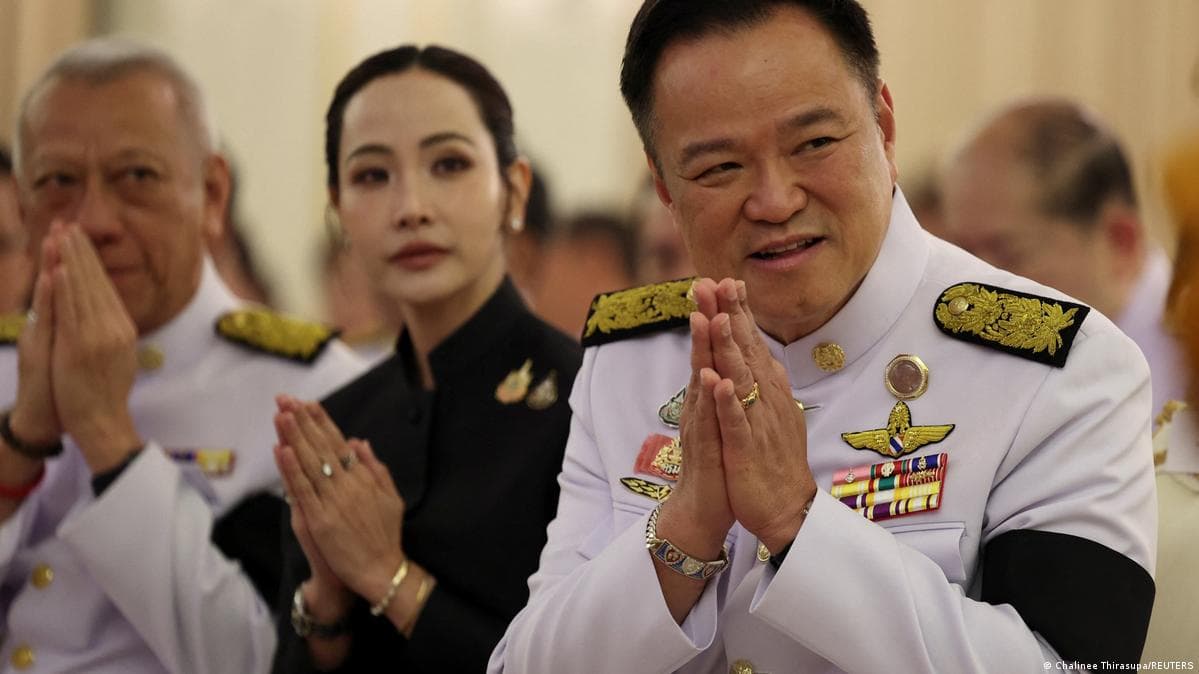
Thailand's election commission confirmed on Monday that early national elections will take place on February 8. Thai Prime Minister Anutin Charnvirakul last week triggered the vote amid a decades-old territorial dispute with neighboringCambodiathat has once again turned deadly. Dozens of people including soldiers and civilians have died on both sides as heavy combat over contested borders entered a second week. The country's parliament was dissolved on Friday after getting approval from King Maha Vajiralongkorn. Anutin claimed on Thursday that he wanted to "return power to the people." By receiving royal backing to dissolve parliament, Anutin avoided a no-confidence vote that could have swiftly ended his tenure. Some analysts say that the PM is capitalizing on anationalist wavewhipped up by the border conflict with Cambodia. To view this video please enable JavaScript, and consider upgrading to a web browser thatsupports HTML5 video "With the rising nationalistic sentiment in the country, that actually works for him because people are quite supportive toward his actions when they compare with the previous government, [which] was not using strong or aggressive action against Cambodia," said Titipol Phakdeewanich, a professor of political science at Thailand's Ubon Ratchathani University. PM Anutin has taken a much tougher tone on the border conflict than his predecessor, Paetongtarn Shinawatra. Thailand's Constitutional Courtremoved Paetongtarn from officeover aleaked phone callwith veteran Cambodian leader Hun Sen in June. In the call, Paetongtarn referred to the elderly former dictator as "uncle," professed love and respect for him, andcriticized her own military commanders— considered a red line in a country where the military has significant clout. Memories of that call will make it hard for Paetongtarn's Pheu Thai party, even under new leadership, to campaign effectively in the current climate, said Napon Jatusripitak, a visiting fellow with the Singapore-based ISEAS-Yusof Ishak Institute. Napon said Thailand's largest party, the People's Party, may struggle because of its reputation for wanting to rein in the military, which younger Thais especially see as wielding undue political influence. The People's Party is a reincarnation of the pro-reform party, Move Forward, whichthe courts dissolved last yearafter ruling that its efforts tosoften the country's lese majeste law— which shields the Thai royal family from criticism — violated the constitution. Move Forward's calls to reform the military served it well in thenational elections of 2023, when itwon the most House seats of any party, said Napon, who is also managing director of the Thailand Future Institute, a local think tank. But amid ongoing clashes with Cambodia, Napon added, "the military is seen as the rightful defender of national sovereignty, so the People's Party's stance … may not play well with some of these more nationalist supporters, which certainly are probably in quite large numbers now." Anutin, thetycoon-turned-politicianwho leads the Bhumjaithai Party, was due to dissolve parliament by late January in any case, as part of a deal he struck in September with the People's Party. In return, the People's Party agreed to back his bid for prime minister. The same deal committed Bhumjaithai to starting the process of rewriting the constitution and putting it to a referendum, another key goal of the People's Party. To view this video please enable JavaScript, and consider upgrading to a web browser thatsupports HTML5 video The day before Anutin won the king's approval last week to dissolve parliament, however, the two parties squabbled over the role the Senate should play in the amendment process. Officially, senators have no party affiliation. But Bhumjaithai has been accused of rigging last year's Senate polls to get some of its preferred candidates elected, which it denies. When Bhumjaithai insisted last week that any constitutional amendment must be approved by at least one-third of the Senate, the People's Party balked and began planning a no-confidence vote. Verapat Pariyawong, a policy fellow at the University of London SOAS, said the conservative Bhumjaithai and reformist People's Party were bound to butt heads over the Senate and the constitution. By pushing to give the Senate what amounts to a veto over any proposed amendments, he said, Anutin very likely anticipated the People's Party's reaction. "It was never his intention to allow the amendment of the constitution to proceed in the way that the [People's] Party expected. So, he basically engineered an excuse to call a new election," and at a time that suited him best, said Verapat. Since taking power following the collapse of the previous administration, Anutin has also convinced several lawmakers to defect to Bhumjaithai and appointed a number of provincial governors who might be able to rally yet more voters to his party. Despite the ceasefire, the border dispute between Cambodia and Thailand has erupted once more. The Cambodian Defense Ministry announced on Tuesday that nine civilians had been killed and 20 others seriously injured since Monday. According to official figures, three soldiers died on the Thai side and 29 people were injured. At the army headquarters in Bangkok, Thai army spokesman Major General Winthai Suvaree gave a briefing on the border situation with Cambodia on Monday. According to a media report, Thailand's army announced its intention to decimate the neighboring country's military with long-term attacks. Cambodia has responded by saying that it would defend itself. These people in Siem Reap packed up their belongings and moved to a shelter. Cambodia's influential former prime minister Hun Sen said on Tuesday that his country had defended itself against Thailand. Phnom Penh had previously denied retaliatory attacks, but Hun Sen emphasized on Facebook that after more than 24 hours of patient waiting, countermeasures had been taken since Monday evening. In the Thai province of Buriram, these families sought refuge in an evacuation center. It was only at the end of October that the two Southeast Asian neighbors signed an agreement brokered by the US that was intended to ensure lasting peace. Following the recent attacks, authorities have urged residents on both sides of the border to flee. It remains uncertain whether the ceasefire can be saved. In the Thai province of Sa Kaeo, a resident shows a damaged part of his house, presumably hit by artillery shells. Both countries have accused each other of breaking the ceasefire. This Buddhist monk in Thailand found shelter in a tunnel. The border dispute revolves around unmarked points along the 817-kilometer (around 500-mile) border, which was mapped by France in 1907 when Cambodia was under colonial rule. At the heart of the dispute is the centuries-old Prasat Preah Vihear temple on the Cambodian side, which has been a UNESCO World Heritage Site since 2008. Both the temple, dedicated to the Hindu god Shiva, and the surrounding area are claimed by Thailand and Cambodia. Anopinion pollpublished on Saturday in theBangkok Postshows most voters are undecided about their choice of PM candidate and political party. In any case, the party with the most seats won't necessarily take power. Post-poll coalition talks could put any number of parties at the head of the next administration. Analysts note that the outcome of the February election will likely impact the government's handling of Thailand-Cambodia border dispute. "If you take the position of Anutin, he's going to be very willing to side with the military leaders, whereas the [People's Party] will be quite the opposite, so Pheu Thai can in the end be a bit of a moderate option," said Verapat. But the military has long had a reputation of standing apart from civilian governments, pledging its loyalties first and foremost to the monarchy. It has staged at least a dozen coups over the past century. "That is the military culture in Thailand … They almost act like they are independent even when we talk about other things, regardless of the border issues," said Titipol. For any administration that emerges from the February 8 vote, he said the lead party would need to win big if it hopes to exert much influence over how the military actually conducts itself on the border. With none of the parties likely to win an outright majority, Napon sees little chance of that happening. "The civilian government will have to demonstrate strong leadership and control over the military before the conflict can be effectively managed, and of course I don't think that's in the picture," he said. Edited by: Keith Walker To view this video please enable JavaScript, and consider upgrading to a web browser thatsupports HTML5 video
Thailand's Prime Minister Triggers Early Elections Amid Deadly Border Dispute with Cambodia
DW•
Full News
Share:
Disclaimer: This content has not been generated, created or edited by Achira News.
Publisher: DW
Want to join the conversation?
Download our mobile app to comment, share your thoughts, and interact with other readers.