
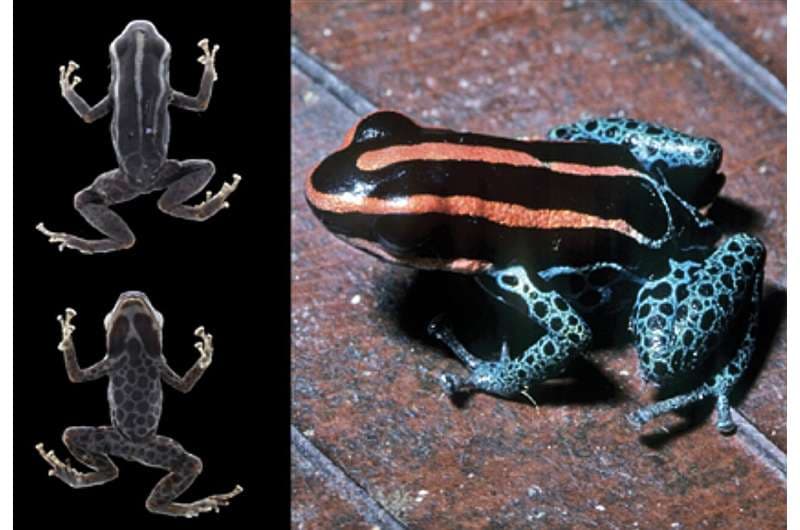
Researchers at the University of Kansas Biodiversity Institute and Natural History Museum recently uncovered a slipup from decades ago: the misidentification of a poison frog specimen from Peru used as a holotype. A holotype is an individual preserved specimen collected in the field and deemed to officially represent an entire species, though today, scientists sometimes use associated data like photos or genetic data as part of the holotype. Their findings arepublishedin the journalZootaxa. "When you describe a species, you assign one specimen that bears the name of that species," said lead author Ana Motta, collection manager of herpetology at the Biodiversity Institute. "If I find something else later that looks like that species, I need to go to the holotype and compare things to know if that new population belongs to that species or is something else. So, the holotype is the specimen that represents the species." In 1999, a researcher saw a published photo of a colorful frog from the Peruvian rainforest, near the Ecuador border. Unable to identify its species, he described the mysterious frog based on that single photo of a specimen previously deposited with KU's herpetology collection, recording it as specimen KU 221832 and bestowing it with the scientific name Dendrobates duellmani.
Misidentified Poison Frog Holotype Uncovered by Researchers at University of Kansas
Phys News•
Full News
Share:
Disclaimer: This content has not been generated, created or edited by Achira News.
Publisher: Phys News
Want to join the conversation?
Download our mobile app to comment, share your thoughts, and interact with other readers.