
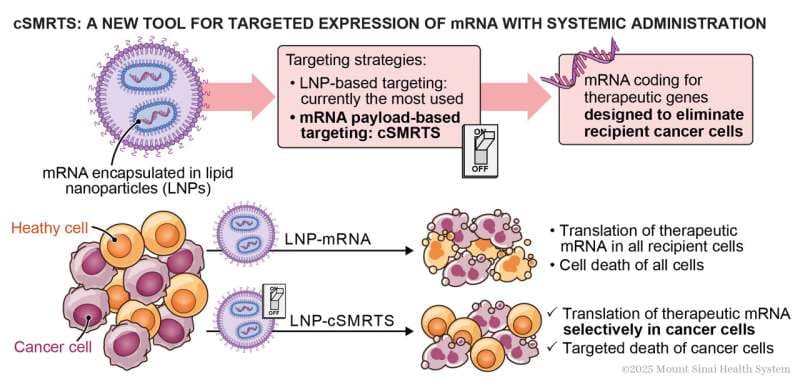
Researchers at the Icahn School of Medicine at Mount Sinai have developed a first-of-its-kind mRNA system that switches on therapeutic genes preferentially inside targeted cells—an advance demonstrated in studies in mice that could lay the groundwork for safer, more precise treatments for cancer and other diseases. The system, called thecell-selective modRNA translation system(cSMRTS), is an engineered form of mRNA designed to activate in specific cell populations. The findings were reported in the November 15 online issue ofMolecular Therapy. The approach builds on lessons from mRNA COVID-19 vaccines, which showed how cells can be turned into "protein factories" to produce helpful molecules. But unlike vaccines—where it doesn't matter which cells produce the protein—treating cancer often requires hitting only tumor cells and sparing healthy ones. That level of precision has been difficult to achieve using currentlipid nanoparticle(LNP) targeting technologies, say the investigators. "Our goal was to rethink how mRNA therapies work. Right now, so much effort goes into trying to deliver mRNA to the right place, and even then you get a lot of off-target effects," says first author Magdalena M. Żak, Ph.D., Instructor in the Cardiovascular Research Institute and the Department of Genetics and Genomic Sciences at the Icahn School of Medicine at Mount Sinai.
Mount Sinai Researchers Develop Groundbreaking mRNA System for Targeted Cancer Treatments
Phys News•
Full News
Share:
Disclaimer: This content has not been generated, created or edited by Achira News.
Publisher: Phys News
Want to join the conversation?
Download our mobile app to comment, share your thoughts, and interact with other readers.