
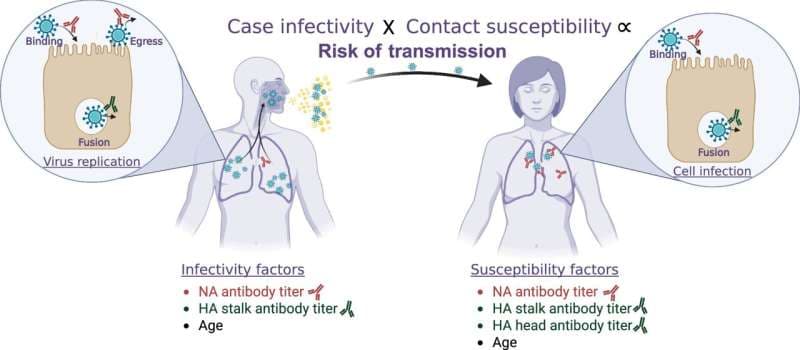
Today's influenza vaccines primarily prevent infection in individuals, but new research led by the University of Michigan and the Institut Pasteur suggests that incorporating antibodies generated after infection could lead to more powerful vaccines by also reducing person-to-person transmission. Future vaccines that boost the antibodies—neuraminidase, or NA, in particular, along with, HA head and HA stalk (HA stands for hemagglutinin)—may add an important layer of community protection, the researchers say. "NA is a part of the influenza virus that has been relatively overlooked in vaccine design, yet they play a key role not only in lowering infection risk but also in reducing how contagious someone becomes when infected," said Aubree Gordon, co-senior study author and director of the Michigan Center for Infectious Disease Threats and Pandemic Preparedness. The study ispublishedin the journalNature Communications. It comes amid warnings of a severe flu season ahead and as the first deaths of the 2025–2026 flu season are being recorded in the Northern Hemisphere. Influenza infects upwards of 1 billion people and leads to some 650,000 deaths globally each year. Lost productivity and hospitalizations due to the flu also result in major economic loss and burden.
Innovative Vaccine Design Could Revolutionize Influenza Prevention, Reducing Community Transmission
Phys News•
Full News
Share:
Disclaimer: This content has not been generated, created or edited by Achira News.
Publisher: Phys News
Want to join the conversation?
Download our mobile app to comment, share your thoughts, and interact with other readers.