
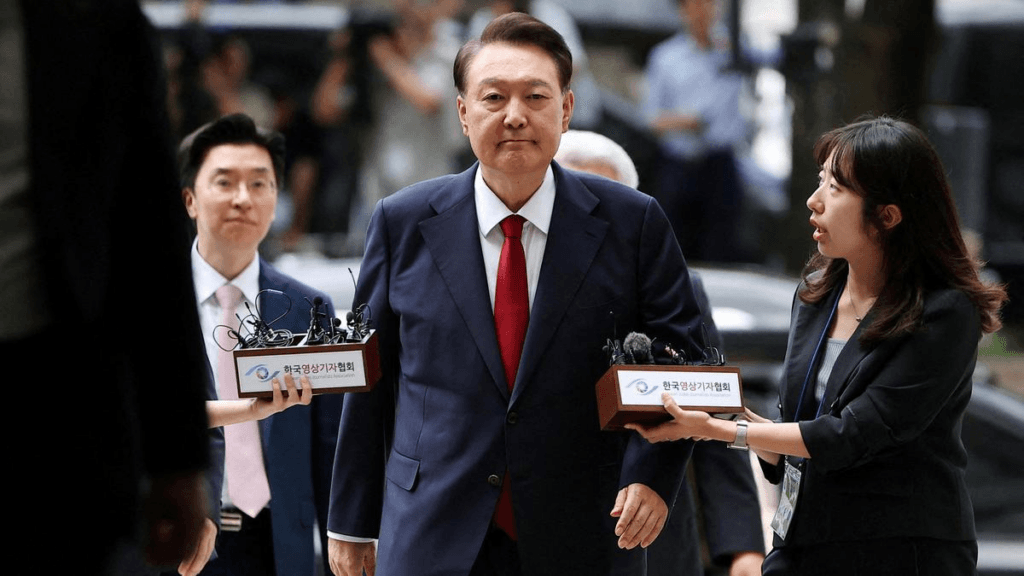
South Korea’s former president, Yoon Suk Yeol, has been sentenced to 30 years in prison after a court found him guilty of authorizing an unauthorized drone operation over North Korea that prosecutors argued was intended to manufacture a national security crisis. The ruling adds to Yoon’s growing legal troubles, coming just months after he received a life sentence in a separate insurrection case linked to his controversial declaration of martial law in 2024. The latest judgment is one of the most significant legal actions taken against a former South Korean president in recent history and has reignited debate over executive power, military authority, and civil-military relations in one of Asia’s most volatile security environments. A South Korean court ruled that Yoon authorized drone flights into North Korean airspace without proper legal or military justification. According to the judge, Yoon intended to provoke Pyongyang “into carrying out armed or equivalent acts against South Korea’s military of people,” AFP reported, citing a summary of the ruling. According to prosecutors, the operation was not part of a routine military mission. Instead, they argued it was deliberately planned to increase tensions with North Korea and create conditions that could later be used to justify extraordinary domestic measures, including Yoon’s declaration of martial law in late 2024. The court accepted key parts of the prosecution’s case, concluding that the former president abused his authority and endangered national security. The case centers on drone flights that allegedly crossed into North Korean airspace in 2024. Investigators said the operation carried significant military risks because it could have triggered retaliation from Pyongyang at a time of already fragile inter-Korean relations. North Korea accused South Korea of sending drones carrying propaganda leaflets, an allegation that fueled tensions between the two countries. According to the court, the operation was designed to provoke a response from North Korea rather than serve a legitimate military objective. The prosecution argued that the drone mission formed part of a broader political strategy. According to the ruling, Yoon intended to heighten military tensions on the Korean Peninsula to create a national security emergency that could justify his controversial declaration of martial law. The judge said the evidence showed an attempt to “heighten inter-Korean military tensions and manufacture a national crisis,” accepting prosecutors’ argument that the alleged security threat was politically motivated rather than driven by genuine defense concerns. The decision connects the drone case directly to the broader investigation into Yoon’s actions while serving as president. Yoon has consistently denied wrongdoing throughout both criminal cases. His legal team argued that the prosecution was politically motivated and maintained that decisions involving national security were taken to protect South Korea from threats posed by North Korea. Yoon has also defended his declaration of martial law, saying it was enacted solely in the nation’s interest. Following Friday’s ruling, he is expected to appeal the conviction. South Korea has a history of former presidents facing criminal investigations after leaving office, but the latest conviction is notable because it involves allegations of using military operations for domestic political purposes. Legal experts say the judgment reinforces judicial oversight of presidential powers, particularly when decisions involve national security and military actions. The ruling also underscores how sensitive relations with North Korea remain, where even limited military incidents can risk wider escalation. Yoon is expected to challenge the 30-year prison sentence through South Korea’s appeals process. While the conviction is significant, it may take months or longer before the legal proceedings are fully concluded. The appeals court could uphold, reduce, overturn, or order a retrial depending on its assessment of the evidence and legal arguments. For now, the latest verdict adds another major conviction to the former president’s legal record and marks a dramatic chapter in South Korea’s political history.
South Korean Ex-President Yoon Suk Yeol Sentenced to 30 Years in Prison for Drone Operation Over North Korea
Breezy Scroll•
Full News
Share:
Disclaimer: This content has not been generated, created or edited by Achira News.
Publisher: Breezy Scroll
Want to join the conversation?
Download our mobile app to comment, share your thoughts, and interact with other readers.