
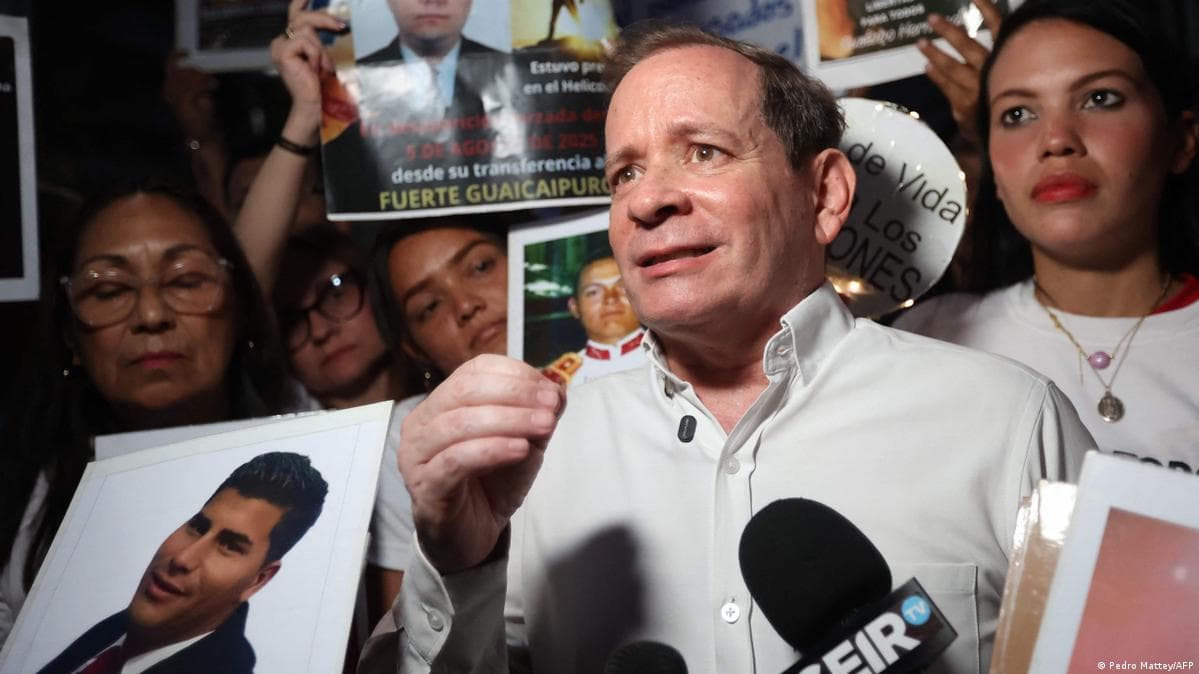
It is not uncommon to hear glowing words aboutVenezuelan unityat the National Assembly in the capital Caracas. Acting President Delcy Rodriguez did not hold back when she presented herdraft amnesty lawfor political prisoners last month. After it was approved in a first reading, Rodriguez said it wasa major step"towards peace and reconciliation." Venezuela's parliament is dominated by toppled former PresidentNicolas Maduro'sUnited Socialist Party of Venezuela (PSUV). A second reading is scheduled for Tuesday. To view this video please enable JavaScript, and consider upgrading to a web browser thatsupports HTML5 video The Venezuelan government claims to have released 900 political prisoners since December 2025. According to the opposition and human rights organizations,prisoners have indeed been releasedbut not as many as the government says. Foro Penal, a Venezuelanhuman rightsorganization, reported that as of February 9, there were 687 political prisoners in Venezuela, down from 887 in November 2025. If these figures are correct, only 200 have been released, though Foro Penal's definition of politically motivated imprisonment is regarded as narrow. The opposition alliance Plataforma Unitaria Democratica claims 391 people have been released so far. To view this video please enable JavaScript, and consider upgrading to a web browser thatsupports HTML5 video Venezuela's interim leader Rodriguez has not acknowledged that the prisoner release was at least partly due tohuge international pressure,especially from theUnited States. Venezuelan political scientist Benigno Alarcon Deza says "the state's capacity for repression remains intact." He adds the mooted closure of El Helicoide, a notorious detention center in Caracas for political prisoners, will not change this. As if to confirm such fears, a close ally of Venezuelan opposition leader and Nobel laureateMaria Corina Machado,Juan Pablo Guanipa, wasre-arrestedon Monday after taking part in a demonstration calling for the release of all political prisoners. He had been freed the day before. The amnesty law itself has also been criticized. For Gonzalo Himiob, the vice president of Foro Penal, the first "legal error" is in the introduction, which describes the law as an "act of mercy." Himiob argues the amnesty should be understood as a decision by the state not to punish people for political reasons rather than as an act of moral forgiveness. He, and other critics of the law in its current form, argue the text reflects a sense of supposed kindness and mercy rather than justice. They say it lacks formulations that clearly identify guilt and responsibility, and excludes crimes such as human rights violations, drug trafficking and murder. Political scientist Benigno Alarcon Deza says: "We should not be surprised if there is even talk of providing amnesty to people from the government itself." Last week, human rights organizations presented their concerns and proposed amendments to the parliamentary committee responsible for the amnesty law. They pointed out certain formulations that might be used as loopholes to rearrest political opponents after their release or even to prevent them from being set free at all. On the online portal Venezuela Politica, Maibort Petit, a Venezuelan journalist who lives in theUS, warned that "a general amnesty could be perceived as a political knee-jerk reaction rather than a genuine process of reconciliation process." He said that structural reforms of the justice system and the state security apparatus were missing. Himiob of Foro Penal also argues that if state repression is to be prevented in future, existing legislation and regulations that allow for political persecution need to be changed. This article was translated from German. To view this video please enable JavaScript, and consider upgrading to a web browser thatsupports HTML5 video
Venezuela's Amnesty Law for Political Prisoners Sparks Criticism
DW•
Full News
Share:
Disclaimer: This content has not been generated, created or edited by Achira News.
Publisher: DW
Want to join the conversation?
Download our mobile app to comment, share your thoughts, and interact with other readers.