
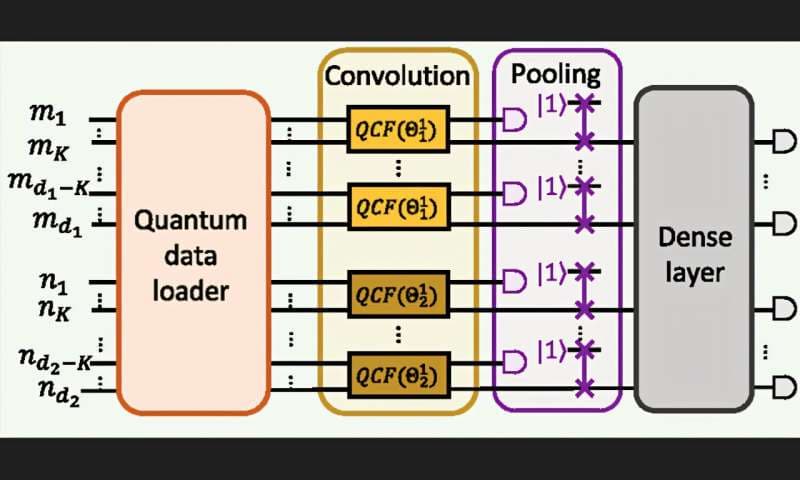
Machine learning models called convolutional neural networks (CNNs) power technologies like image recognition and language translation. A quantum counterpart—known as a quantum convolutional neural network (QCNN)—could process information more efficiently by using quantum states instead of classical bits. Photons are fast, stable, and easy to manipulate on chips, making photonic systems a promising platform for QCNNs. However, photonic circuits typically behave linearly, limiting the flexible operations that neural networks need. In a studypublishedinAdvanced Photonics, researchers introduced a method to make photonic circuits more adaptable without sacrificing compatibility with current technologies. Their approach adds a controlled step—called adaptive state injection—that lets the circuit adjust its behavior based on a measurement taken during processing. This extra control moves photonic QCNNs closer to practical use. The team built a modular QCNN using single photons from a quantum-dot source and two integrated quantum photonic processors. Like a classical CNN, the network processes information in stages. After the first stage, part of the light signal is measured.
Researchers Develop Method for Adaptable Photonic Circuits to Power Quantum Convolutional Neural Networks
Phys News•
Full News
Share:
Disclaimer: This content has not been generated, created or edited by Achira News.
Publisher: Phys News
Want to join the conversation?
Download our mobile app to comment, share your thoughts, and interact with other readers.